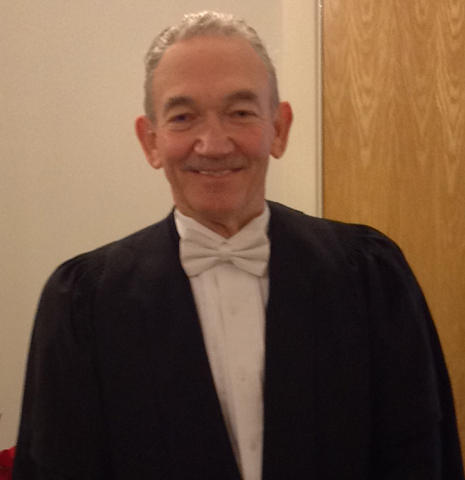
FAYETTEVILLE, Ark. — One evening last fall a group including
students and faculty at Oxford University in England gathered to hear historian
Randall Woods speak about Lyndon Johnson and the Great Society.
Wearing a black gown — the traditional academic dress at the oldest university in the English-speaking world — Woods began his remarks.
“Instead of sleeping, President Johnson spent most of his first few nights as chief executive sitting up with his aides, filling yellow legal pads with legislative proposals that were intended to do nothing less that reconfigure America,” said Woods, a Distinguished Professor and John A. Cooper Professor of History in the J. William Fulbright College of Arts and Sciences at the University of Arkansas.
The delivery of the John G. Winant Inaugural Lecture at Oxford was the culmination of Woods’ appointment as the John G. Winant Visiting Professor of American Government at Oxford for the fall 2013 term.
“It was advertised for weeks on campus and there were more about 100 people there,” said Woods, who returned to teaching this spring. “I spoke about the Great Society as a reform movement in the context of a 20th century reform movement, comparing it with populism and progressivism and the New Deal. The British seem very interested in what I have written about, especially my book about LBJ.”
Indeed, Woods received strong reviews for his 2006 biography of the 36th president — LBJ: Architect of Ambition. Columbia University historian Alan Brinkley raved: “Woods has produced an excellent biography that fully deserves a place alongside the best of the Johnson studies yet to appear.”
To listen to Woods’ Winant Lecture, click here.
The Winant Professorship was established by Rivington Winant, whose father, John, served as U.S. ambassador to Great Britain from 1941-1946 and played a major role in forging the wartime alliance. Recipients of the visiting professorship deliver 24 lectures in American politics and history. The Winant Inaugural Lecture is given annually at the Rothermere American Institute, Oxford’s interdisciplinary establishment for the study of U.S. history, politics, international relations and literature.
The Winant Professor is a fellow of Balliol College — the oldest college at Oxford — and participates in the intellectual life of the Rothermere American Institute. The faculty and students at Oxford are very “institutionally oriented,” said Woods, so his presence there meant exposure for the University of Arkansas.
“They are Oxford, and in the English-speaking world, that is the coin of the realm,” he said. “The Eastman Professor, the other named professor at Balliol, is at Princeton. They don’t get many people from state universities in the United States, and they are used to associating the individual with the institution. They wanted to know about the university, the students and the environment. Intellectually, it helped put us on the map.”
In addition to the Winant Lecture, Woods also participated in a panel discussion on the 50th anniversary of the assassination of John F. Kennedy and the transition to Johnson. He also served as an internal examiner for doctoral dissertations at Oxford and an external examiner for dissertations at Cambridge University.
Candidates for the visiting professorship are expected to be
“intellectually eminent” in American government or history. Woods is a
recognized scholar in the field of U.S. diplomatic history, and has published
seven books on various topics including Vietnam, the Cold War and Sen. J.
William Fulbright.
“The Winant Professorship has attracted some of the world's leading scholars of American politics and political history and Dr. Woods certainly lived up to that tradition,” said Nigel Bowles, director of the Rothermere American Insititute.
The professorship marked Woods’ return to England after serving as a Mellon Scholar at Cambridge University in April 2012, where he worked with graduate students and gave lectures on U.S. diplomatic history and the Johnson administration.
Contacts
Randall Woods, Distinguished Professor
History
479-575-5097, rwoods@uark.edu