
Read the transcript below.
FAYETTEVILLE, Ark. – "It was leaves, leaves and more leaves, but they have the teeth of a fruit-eater. ... Clearly these Macaques hadn't read the literature on tooth form and function."
What did our ancestors eat? What do their fossil remains — in this case, teeth — tell us about diet and evolution?
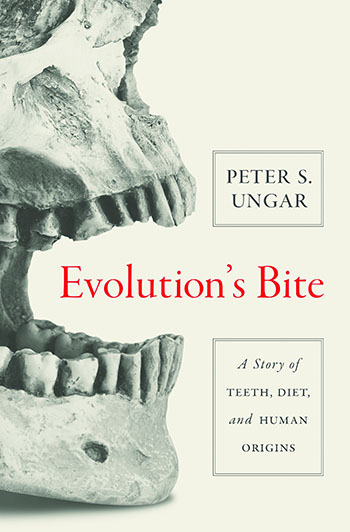
In this new episode of Short Talks From the Hill, a podcast from the University of Arkansas, Peter Ungar reads excerpts from Evolution's Bite, his new book about the fossil teeth of hominids, or human ancestors. He explains how these teeth offer clues about the diet of early humans and evolution.
 Ungar is a Distinguished Professor of anthropology in the J. William Fulbright College of Arts and Sciences and director of the Environmental Dynamics Program at the University of Arkansas.
Short Talks From the Hill highlights research and scholarly work at the University of Arkansas. Each segment features a university researcher discussing his or her work.
Podcast Transcript
Short Talks From The Hill is a podcast highlighting research and scholarly work across the University of Arkansas campus. Each segment features a university researcher discussing his or her work. This segment was posted May 23, 2017.
Delani Bartlette: Hello and welcome to Short Talks from the Hill, a podcast from the University of Arkansas. My name is Delani Bartlette. On this episode, Peter Ungar, Distinguished Professor of Anthropology and director of the Environmental Dynamics Program will read excerpts from his new book Evolution’s Bite, which presents his research with fossil hominid or human ancestor teeth and the clues they give us about our ancestor’s diets. Welcome.
Peter Ungar: Thank you.
DB: So, you’ve got some information for us here. You’ve got a piece, talking a little bit about how teeth are used. Do you want to read us about that a little?
PU: Sure. This is from chapter two. “You’re not supposed to do that” I told my wife, Diane as I transcribed field notes by the light of our kerosene lamp at Ketambe, our research station in Indonesia’s Gunung Leuser National Park. We had just arrived in the rain forest only a week before and I had just finished following Guhantara, a group of small tail Macaques that live in a small patch of rain forest along the left bank of the Alos River. Page after page of dietary observations. It was leaves, leaves and more leaves, but they have the teeth of a fruit-eater. Their incisors are large, for peeling husks, and their molars have short crests and rounded cusps for pulping food flesh. The common name for their biological sub- family is even “fruit eating monkeys.” Clearly these Macaques hadn’t read the literature on tooth form and function. I realized that night that it’s one thing to study teeth in the laboratory and another entirely to see how they’re actually used by primates in their natural habitat. Both are important. The take-home message is, as I learned during my first weeks at Ketambe, there’s more to food choice than teeth. Yes, teeth are important. They give an animal access to food that would otherwise off their table. But primates also have to worry about getting the right mix of nutrients to meet their nutritional needs. Contend with competitors and avoid predators while feeding. Then there’s the issue of availability. Potential appear and disappear in the forest like daily specials at the corner deli.
DB: That’s a good point. From that you also talk about looking at the fossil teeth. Do you want to tell us a little bit about that?
PU: Sure. I’ll do just one more short reading from the final chapter of the book. And that gives my perspective on the Paleo-diet or the Paleolithic diet actually. Paleo-diet refers to a very specific trademark diet. The Paleolithic diet is a myth. Food choice is as much about what’s available to be eaten as it is about what a species evolved to eat. Just as foods appear and disappear from the forest throughout the year, dishes have put out and taken away as our world has changed over time. That change has driven our evolution. Even if we could, and we can’t reconstruct the nutrient content of foods eaten by a specific hominin, the information would be meaningless for planning a menu based on our ancestral diet. Because our world was ever-changing, so too was the diet of our ancestors. Focus on our ancestor at one point in our evolution would be futile. We’re a work in progress. What was the ancestral human diet? The question itself makes no sense.
DB: That’s excellent, thank you so much for coming in and reading this. The book is Evolution’s Bite. It’s been released this month?
PU: Correct.
DB: By Princeton University Press. Thank you.
DB: Music for Short Talks from the Hill was written and performed by Ben Harris, guitar instructor at the University of Arkansas.
Contacts
Matt McGowan, science and research communications officer
University Relations
479-575-4246, dmcgowa@uark.edu