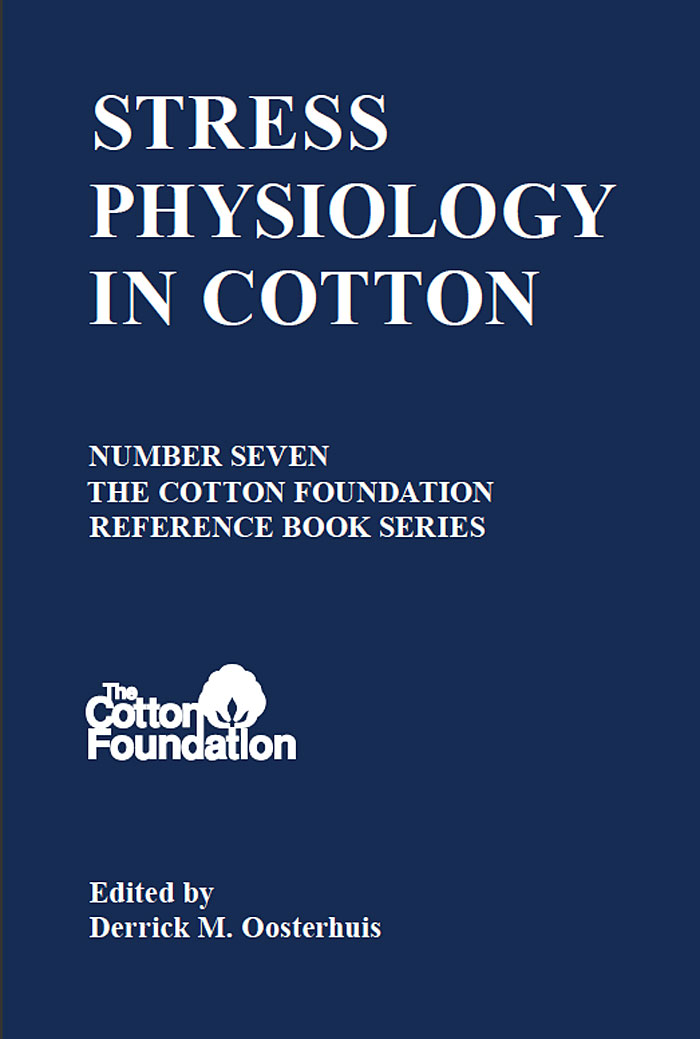
FAYETTEVILLE, Ark. -- Growing cotton is an exercise in stress management for the plants, as well as for farmers. That's the precept of a new book, Stress Physiology in Cotton, edited by Derrick Oosterhuis, Distinguished Professor of crop, soil and environmental sciences, University of Arkansas System Division of Agriculture.
The 160-page paperback is the seventh in the Reference Book Series started in 1986 by The Cotton Foundation, Cordova, Tenn. It is mainly for scientists and serious students of cotton physiology, although that does not rule out readers who grow cotton for a living.
"The effect of temperature, moisture, nutrition and pest attacks on cotton growth and yield depends upon the severity and timing of the stress and the ability of the plant to respond and adapt to it," Oosterhuis said.
Very high mid-summer temperatures are one of the main stressors of cotton plants and farmers who grow them, Oosterhuis said. He has documented that summer temperature variation is closely associated with year-to-year variation in cotton yields in the Mississippi Delta.
Record high temperatures in parts of eastern Arkansas in 2011 likely caused some reduction in yields this year, Oosterhuis said. That's because, unlike the heat wave in 2010, the excessive temperatures occurred this year when plants were flowering, which is the most critical time for boll development.
The average daily maximum temperature during boll development in 2011 was well above the ideal range of 86 degrees Fahrenheit in the day and 68 at night.
"At day temperatures above 95 degrees Fahrenheit, there is a significant decrease in leaf growth and carbohydrate production due to significantly decreased photosynthesis and increased respiration," Oosterhuis said.
He adds that when night temperatures are over about 75, respiration increases. Respiration in plants is the intake of carbon dioxide, which is converted to sucrose, and, during daylight, exhalation of oxygen as a waste product of photosynthesis. At night, when photosynthesis does not occur, no oxygen is produced and carbon dioxide is exhaled.
Increased respiration due to high night temperatures "causes an additional loss in carbohydrates resulting in insufficient available carbohydrate (sucrose) to satisfy all the plant's needs and thereby causing increased fruit abscission (loss of bolls) and less fiber per seed. There may also be less seed per boll and smaller seed. High night temperatures also delay flowering and affect pollination."
In Arizona, Australia, California and Greece the average yield per acre of cotton is up to 50 percent more than in the Mississippi Delta. That's mainly because night temperatures in those areas are up to 10 degrees Fahrenheit cooler than in the Mississippi Delta during boll development, Oosterhuis said.
Also, as visitors to those places know, the heat is dryer than it is here. Lower humidity promotes evaporation, which keeps tourists and cotton plant leaves cooler than in the humid Delta.
A chapter in the book titled, "High Temperature Stress on Floral Development and Yield of Cotton," by Oosterhuis and John L. Snider, a soil scientist at the USDA Dale Bumpers Small Farm Research Center, Booneville, provides a detailed review of the scientific literature on that subject.
The book is available on The Cotton Foundation website at http://ncga.cotton.org/foundation/stressphyscontents.cfm.
Contacts
Howell Medders, coordinator
AGCS
575-5647, hmedders@uark.edu